
Journal of Networking and Network Applications
Editor-in-Chief: Norio Shiratori, IEEE Life Fellow, Chuo University, Japan
Associate Editors-in-Chief:
Pin-Han Ho, IEEE Fellow, University of Waterloo, Canada
Xiaohong Jiang, Future University Hakodate, Japan
Yulong Shen, Xidian University, China
Email: [email protected] ISSN: 2689-7997(Online), No fees to publish articles in this journal
Paper Submission: https://www.manuscriptmanager.net/jnna
Google Scholar: https://scholar.google.ca/citations?user=eQuV6NwAAAAJ&hl=en&authuser=1
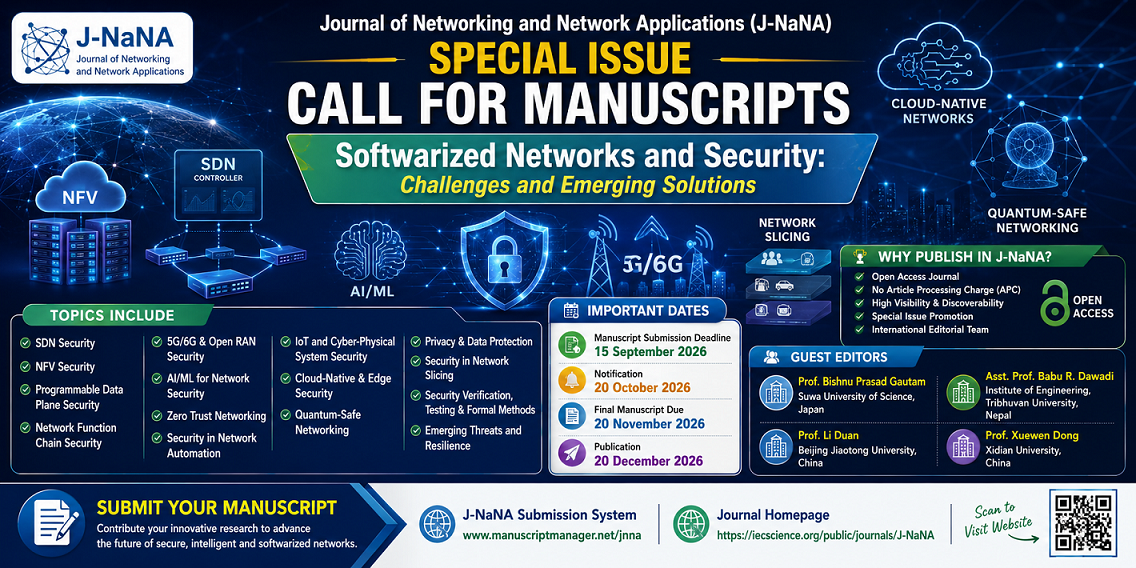
I. Special Issue on Softwarized Networks and Security: Challenges and Emerging Solutions
1. Aims and Scopes
The rapid evolution of communication networks toward highly programmable, virtualized, cloud-native, and intelligent infrastructures has transformed the design, deployment, and operation of modern networking systems. Technologies such as Software-Defined Networking (SDN), Network Function Virtualization (NFV), network slicing, intent-based networking, Quantum Networking, and AI-driven network management are enabling unprecedented flexibility, scalability, and automation in next-generation networks. While these advances offer significant operational benefits, they also introduce new security challenges arising from increased programmability, centralized control architectures, virtualization layers, multi-tenant environments, dynamic service orchestration, and software-defined control mechanisms. Ensuring the security, privacy, trustworthiness, resilience, and dependability of softwarized networks has therefore become a critical research priority for future Internet infrastructures, 5G/6G systems, industrial networks, and cyber-physical systems.
This Special Issue aims to bring together researchers, practitioners, industry experts, and policymakers to present cutting-edge research, innovative methodologies, practical solutions, and emerging trends addressing security challenges in softwarized networking environments. The issue seeks high-quality original contributions that advance the state-of-the-art in securing programmable, virtualized, autonomous, and intelligent networks. This Special Issue welcomes theoretical, experimental, simulation-based, and practical contributions covering, but not limited to the following topics:
A. Security in Software-Defined Networking (SDN)
SDN control plane security
Secure SDN controllers and controller placement
East-West and North-South interface protection
Secure flow rule management
SDN attack detection and mitigation
Distributed denial-of-service (DDoS) defense in SDN
Threat modeling and vulnerability assessment in SDN environments
B. Security of Network Function Virtualization (NFV)
Secure virtual network functions (VNFs)
VNF isolation and multi-tenancy security
NFV orchestration and management security
Hypervisor and container security
Secure service function chaining
Trust management in NFV infrastructure
C. Programmable Data Plane Security
P4-based network security mechanisms
Security of programmable switches
Data plane monitoring and anomaly detection
Runtime verification of programmable forwarding behaviors
Secure in-network computing
D. 5G, Beyond 5G, and 6G Network Security
Security of network slicing
Open RAN (O-RAN) security
Security in virtualized radio access networks
Secure service orchestration in 5G/6G
AI-native security architectures for 6G
Security challenges in ultra-low latency and massive IoT deployment
E. Artificial Intelligence and Machine Learning for Network Security
AI-driven threat detection and response
Federated learning for network security
Explainable AI for security analytics
Adversarial machine learning in networking
Intelligent intrusion detection systems
Autonomous security orchestration and remediation
F. Zero Trust and Identity-Centric Networking
Zero-trust networking architectures
Identity and access management
Continuous authentication and authorization
Trust frameworks for programmable networks
Policy-driven security management
G. Secure Network Automation and Orchestration
Intent-based security management
Secure network automation frameworks
Policy verification and compliance
Security-aware orchestration
Autonomous network security operation
H. Internet of Things (IoT) and Cyber-Physical Systems Security
Secure IoT networking architectures
Industrial IoT and Industry 4.0 security
Smart city network security
Secure edge intelligence
Trustworthy cyber-physical infrastructure
I. Emerging Security Challenges
Quantum-safe networking security
Post-quantum cryptography for programmable networks
Digital twins for network security assessment
Security of autonomous and self-driving networks
Green networking and security trade-offs
Security for integrated terrestrial-satellite networks
Resilience against advanced persistent threats (APTs)
J. Security Measurement, Verification, and Testing
Formal methods for network security verification
Security benchmarking and evaluation
Digital forensics in Softwarized networks
Security testing and penetration analysis
Network resilience and survivability assessment
2. Special Issue Editors

Guest Editor: Prof. Bishnu Prasad Gautam
Email: [email protected]
Website: https://researchmap.jp/gautambp?lang=en
Suwa University of Science, Nagano, Japan
Interests: Computer Networks, Network Management and Monitoring, AIoT

Guest Editor: Asst. Prof. Babu R. Dawadi
Email: [email protected]
Website: www.baburd.com.np
Dept. of Electronics and Computer Engineering, Pulchowk Campus, Institute of Engineering, Tribhuvan University, Kritipur, Nepal
Interests: IoT and Edge Network Security, Intelligent Networking, Distributed Computing

Guest Editor: Prof. Li Duan
Email: [email protected]
Website: http://faculty.bjtu.edu.cn/9432/
School of Cyberspace Science and Technology, Beijing Jiaotong University, Beijing, China
Interests: AI Security, Blockchain and Privacy Computing

Guest Editor: Prof. Xuewen Dong
Email: [email protected]
Website: https://faculty.xidian.edu.cn/DXW/zh_CN/index.htm
School of Computer Science and Technology, Xidian University, Xi'an, China
Interests: Blockchain, SDN Security, AI Security
3. Author’s Guidelines
The submissions should follow the formatting guidelines of the Journal of Networking and Network Applications (https://iecscience.org/public/ueditor/php/upload/file/20200202/1580614065642302.zip). Any questions regarding this special issue should be sent to the guest editors. All submitted papers will be reviewed by at least three reviewers and selected based on their originality, significance, relevance, and clarity of presentation. The manuscript should be prepared in J-NaNA Latex standard and converted into a PDF for auto-submission system. Electronic paper should be submitted to the J-NaNA Submission System at https://www.manuscriptmanager.net/jnna.
4. Keywords
Softwarized Networks
Network Security
SDN Security
IBN Security
NDN Security
Post-Quantum Security
Quantum-Safe Networking
Zero Trust Networking
Security Orchestration
Network Slicing Security
Open RAN Security
Edge Computing Security
Container Security
Kubernetes Security
AI for Cybersecurity
Machine Learning for Network Security
IoT Security
Industrial IoT Security
Cyber-Physical Systems Security
Secure Telemetry,
Network Monitoring and Analytics
5. Publication Schedule
Manuscript Submission Deadline: September 15, 2026
Notification of Acceptance/Rejection/Revision: October 20, 2026
Final Manuscript Due: November 20, 2026
Tentative Publication Date: December 20, 2026
Details about this special issue is available for download by the link  J-NaNA 2026SI--Softwarized Networks and Security.pdf
Special Issues are an important component of IEC journals. They deal with more focused topics with high current interest falling within the scope of the journal in which they are published. They should be organized by recognized experts in the area and attract articles of the highest quality. Special Issue proposals are welcome at any time during the year.
Benefits of Publishing in a Special Issue
Ease of navigation: Grouping papers by topic helps scholars navigate broad scope journals more efficiently.
Greater discoverability: Special Issues support the reach and impact of scientific research. Articles in Special Issues are more discoverable and cited more frequently.
Expansion of research network: Special Issues facilitate connections among authors, fostering scientific collaborations.
External promotion: Articles in Special Issues are often promoted through the journal's social media, increasing their visibility.
Special Issues with more than 5 articles can be published, ensuring wide and rapid dissemination.
The Article Processing Charge (APC) for publication in this open access journal is No fee.
Proposals for Special Issues should be submitted by the Lead Guest Editor of the Special Issue and should include the following:
Special Issue Title
Lead Guest Editor (Including full name, email address, affiliation information)
Guest Editor (Including full name, email address, affiliation information)
Note: Affiliation information should include your department, university, city and country or institution, city and country.
Submission Deadline
Publication Date
Description: A 150-400 words summary about your Special Issue
If you would like to propose a Special Issue and be the Lead Guest Editor, please download Proposal Form below, fill it out and send to [email protected].
